What oak wilt actually is
Oak wilt is caused by Bretziella fagacearum, a fungus that colonises the water-conducting vessels of oak trees. The tree responds by plugging those vessels to wall the fungus off, and in doing so cuts off its own water supply. The wilting you eventually see is the tree effectively strangling itself.
It has killed more live oaks in Central Texas than any storm on record. In parts of West Austin, Rollingwood and the Lakeway corridor, entire streets have lost their canopy over two or three decades.
The two ways it spreads
Underground, through connected roots
This is the one people underestimate. Live oaks do not grow as separate individuals. Neighbouring trees fuse their root systems into a shared network, so a stand of live oaks along a street is closer to one organism than to twenty. The fungus moves through those grafts.
This is why oak wilt advances as a visible front, tree by tree in one direction, rather than appearing randomly. Around 90% of local spread happens this way.
Above ground, on beetles
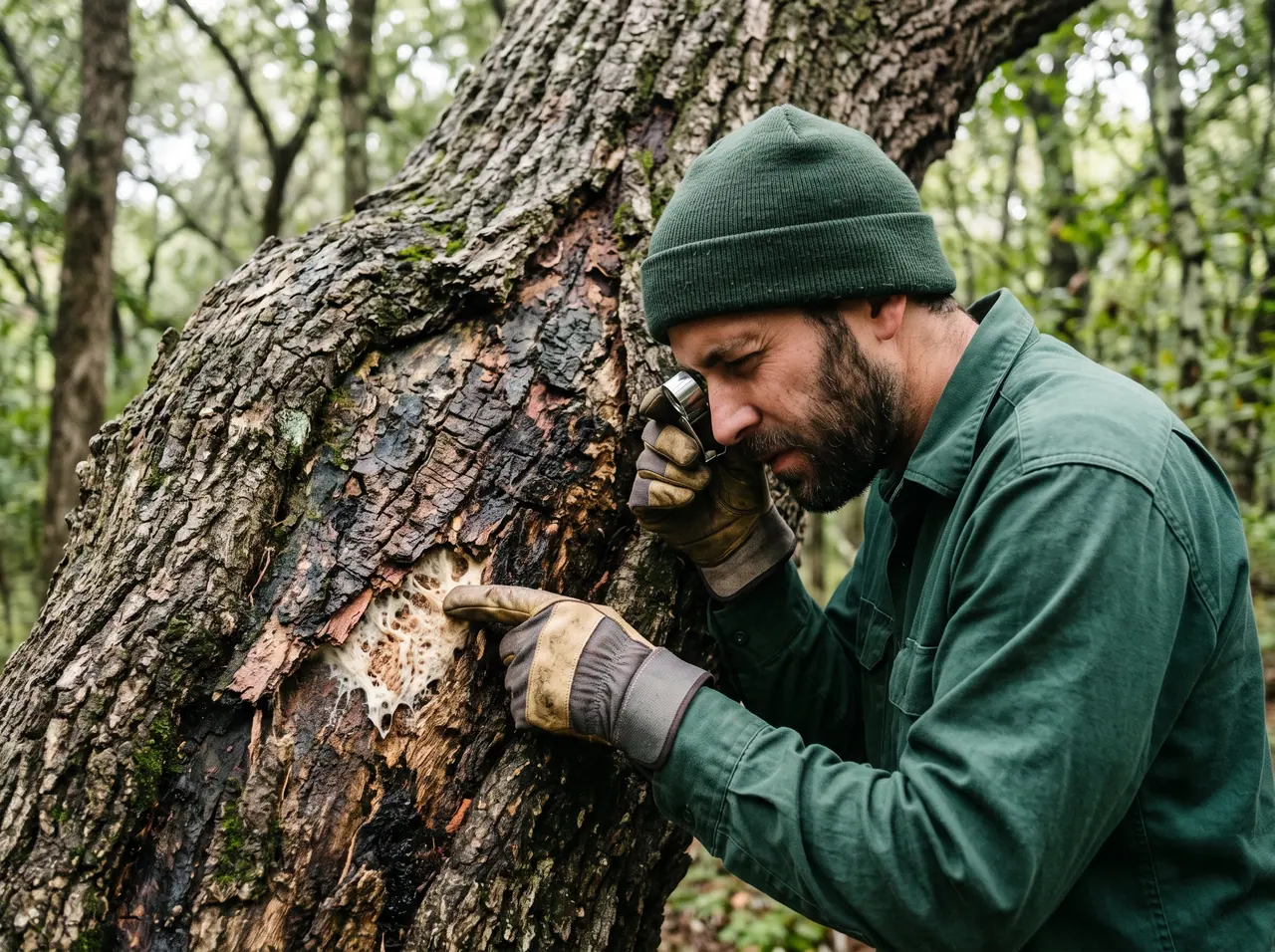
Sap-feeding nitidulid beetles feed on the fungal mats that form under the bark of dead red oaks. They then fly to fresh wounds on healthy oaks, carrying spores with them. A pruning cut, a storm break, or damage from a mower can all be the entry point.
The beetles are most active from February through June. That single fact is the reason for the pruning calendar every arborist in this region will give you.
Reading the symptoms
Live oaks show veinal necrosis, and it is quite specific. The veins of the leaf turn yellow and then brown while the tissue between the veins stays green for a while longer. Held up to the light, the leaf looks like a green sheet with a brown skeleton drawn through it. Trees typically shed leaves heavily and decline over one to three years.
Red oaks, including Spanish oak, Shumard and blackjack, behave differently and far more aggressively. Leaves turn a dull bronze or brown from the tips inward, often across the whole crown within weeks. Dead red oaks frequently hold their brown leaves through winter instead of dropping them, which is a useful field sign.
Live oaks and red oaks together declining in one direction across adjacent properties is the pattern that should prompt a call.
What it is not
Not every struggling oak has oak wilt, and the treatments have nothing in common. The common look-alikes in Central Texas are:
- Hypoxylon canker, which produces a distinctive silver or tan crust as the bark sloughs away, and follows drought stress rather than causing it
- Root rot, usually on trees in poorly drained or over-irrigated ground
- Construction damage, where compaction or a grade change two or three years earlier is only now showing in the crown
- Drought stress, which after 2011 and 2022 accounts for an enormous amount of decline in this region
- Girdling roots, where a root circles the trunk and slowly throttles it, often traceable to how the tree was planted
Getting the diagnosis right first is the entire job.
What treatment can and cannot do
Propiconazole macro-infusion injects fungicide directly into the tree vascular system through the root flare. It is genuinely effective as protection for healthy, high-value oaks near a known infection centre. It is much less effective as a rescue: a tree that has already lost a third of its crown is a poor candidate, and an honest arborist will tell you so rather than take your money.
Injection needs repeating roughly every 18 to 24 months while pressure continues.
Trenching severs the root grafts. A trench cut four feet deep along a properly mapped line is the single most effective intervention available, because it addresses the route 90% of the spread actually takes. Placement is everything: too close to the visible symptoms and the fungus is already past it.
Removing infected red oaks and disposing of the wood correctly prevents new spore mats forming. This is the cheapest thing on the list and the most frequently skipped.
The pruning calendar, in one line
Prune oaks July through January. Do not prune February through June. If storm damage forces a cut in spring, paint every wound within minutes, not hours.
Pruning paint is otherwise discouraged in modern arboriculture because it slows natural compartmentalisation. Oaks in Central Texas during beetle season are the one clear exception, and it is not a close call.
When to call someone
Call if you see veinal yellowing on a live oak, a red oak that browned rapidly, fungal mats or cracked bark on a dead oak, or several neighbouring oaks thinning together over one or two seasons.
Early diagnosis genuinely changes the outcome, because the trees worth protecting are the healthy ones next door.