Greater Austin
Cabling & Bracing
Hardware support that keeps a structurally weak but otherwise healthy tree standing.
- Typical range
- $450 - $1,600
- Per tree, depending on number of cables and canopy height.
- Booking
- 5 to 8 days
- Emergencies same day, 24 hours.
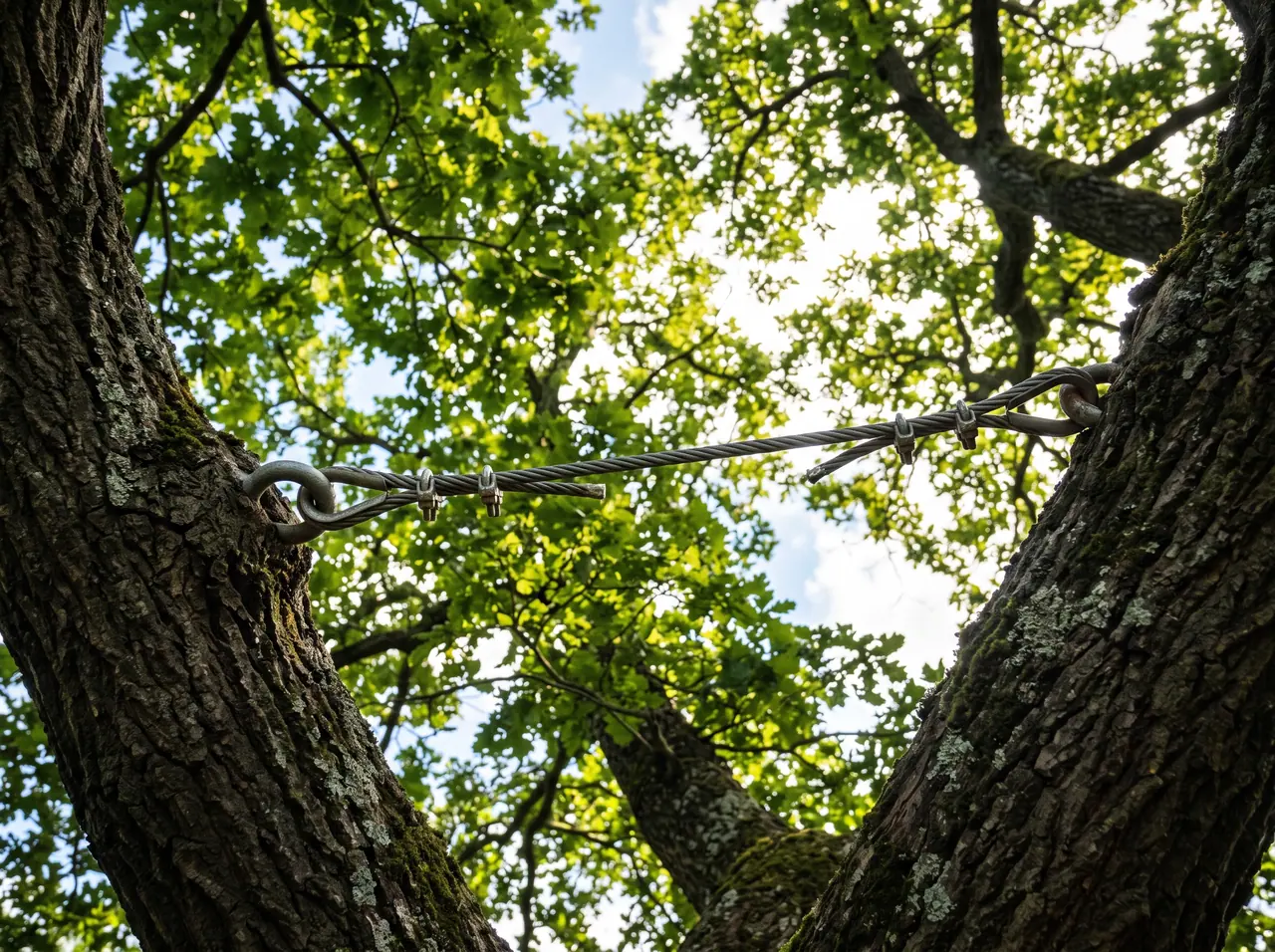
A great many Central Texas live oaks grow with co-dominant stems: two or more trunks of similar size splitting from one point low on the tree. Where those stems meet, bark often becomes trapped in the union instead of the wood knitting together. That included bark union looks solid for decades and then fails in a single gust, usually taking half the tree and whatever is underneath it.
Cabling addresses that directly. A flexible steel cable installed high in the canopy, typically two thirds of the way from the union to the branch tips, limits how far the stems can move apart under load. It does not immobilise the tree, and it should not. Trees need to move to build reaction wood. It limits the extreme movement that causes failure.
This is preventative work, and the economics are usually compelling. Where a homeowner has been told a beautiful mature oak has to come down because of a structural defect, a properly engineered cable system often keeps it standing for another twenty years at a fraction of the removal cost.
What is included
- Structural evaluation
- An arborist assesses the union, checks for included bark and existing cracks, and determines whether hardware is genuinely appropriate.
- Dynamic cable systems
- Synthetic dynamic cabling that allows natural movement while limiting extremes, which suits many healthy trees best.
- Static steel systems
- Extra-high-strength steel cable with through-bolt anchors where the defect requires firmer restraint.
- Through-rod bracing
- Threaded steel rods installed through a split union to hold it mechanically, usually alongside cabling above.
- Lightning protection
- Copper conductor systems for high-value specimen trees, which matters on the exposed properties west of the city.
- Annual inspection
- A yearly check to confirm hardware integrity and that the tree has not grown around the anchors, included for the first two years.
How we approach it
- 01
Assess the defect
The union is inspected closely for included bark, cracking and decay, and we confirm the tree is otherwise healthy enough to justify support.
- 02
Design the system
Cable count, placement height and hardware rating specified to ANSI A300 Part 3 for the actual size and geometry of the tree.
- 03
Install in canopy
Anchors installed correctly and cable tensioned to limit extreme movement without restricting normal flex.
- 04
Document and monitor
Installation photographed and recorded, with annual inspections scheduled to check hardware and growth.
What drives the price
Nobody can quote this accurately over the phone, and any company that does is guessing. These are the five things an arborist is actually assessing when they walk your property.
- Number of cables
- A single union needs one cable. A three-stem tree with multiple weak attachments may need a triangular system of three or more.
- Canopy height
- Cables belong high in the crown, so a 70-foot oak requires substantially more climbing time than a 30-foot ornamental.
- Hardware type
- Dynamic synthetic systems and static steel through-bolt systems differ in cost, and the defect determines which is appropriate.
- Bracing requirement
- Where a union has already begun to split, through-rod bracing is needed in addition to cabling, which adds materials and time.
- Access
- Trees that can only be reached on rope, with no bucket access, take longer to rig and install.
Cabling & Bracing questions
Cabling installs flexible steel or synthetic cable high in the canopy to limit how far limbs can move apart in wind. Bracing installs rigid threaded rods directly through a weak or split union to hold it together mechanically. Cabling is preventative and far more common. Bracing is used where a union has already begun to fail, and the two are frequently installed together.
A properly installed system typically lasts 15 to 20 years, but it is not fit-and-forget hardware. Trees grow around anchors and cables can loosen or become embedded. Annual inspection is essential, and we include it free for the first two years. Systems generally need adjustment every five to seven years as the tree adds girth.
No, and any company that tells you otherwise is overselling. Cabling meaningfully reduces the likelihood of failure at a specific structural defect. It does not make a tree storm-proof, and it does nothing for root problems, trunk decay below the union or a completely different limb. It is one mitigation measure within a wider assessment.
Usually by a wide margin. A cable system at $450 to $1,600 compares with $1,200 to $3,200 for removing the same mature tree, before you consider stump grinding, replanting and the twenty years it takes a replacement to provide comparable shade. Where the tree is otherwise healthy, cabling is normally the better decision financially and environmentally.
Sometimes. If the split is recent, limited in extent and the wood is otherwise sound, through-rod bracing combined with cabling above can hold it and allow the tree to compartmentalise the wound. If the split runs deep into the trunk or decay has taken hold, the tree is generally beyond saving and we will tell you that plainly.
Often needed alongside
Arborist Consulting & Risk Assessment
Written, defensible assessments for permits, construction, disputes and insurance.
Read moreTree Trimming & Pruning
Structural pruning that improves the health of the tree instead of just making it smaller.
Read moreTree Health & Oak Wilt Management
Diagnosis and treatment for oak wilt, decline and pests, from the people who see it every week.
Read moreCabling & Bracing across Greater Austin
We carry out this work in every city we serve, with no travel surcharge. Local soil, species and permit rules differ, so each city page covers what actually changes.
Free on-site visit
Ready to book cabling & bracing?
Free on-site estimate from an arborist, a fixed written price before we start, and full cleanup when we finish.